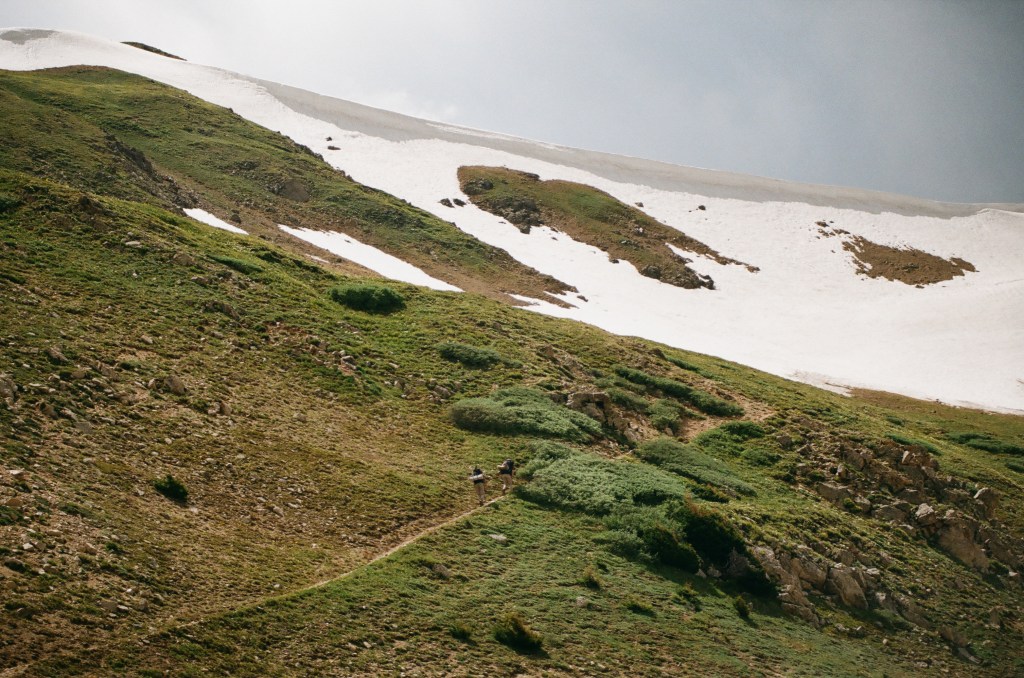
Photograph by Taylor Wilson
“It’s like climbing a mountain; one step at a time,” is a mantra oft-repeated to M1s and pre-Meds. To us, who have been made aware of the realities of the process, this phrase brings little comfort. To me, it was just a metaphor for the duration of our shared journey; even though it sucked, each Anki card, each exam, each hour in the library inched you closer to your goal. A reminder of the big paycheck at the summit. The performance of mountain climbing is a much more complex experience than the phrase reveals. A mountain stream may have rotted away the shoddy bridge of 2x4s that two of your friends crossed, but your weight broke the beam, soaking your boots for the last vertical 2,000 feet. You may spend 2 hours sitting silent in a mosquito-filled mudflat, ignorant to the bites as you gaze over a crystal alpine lake, watching a marmot scurry over the blinding snow. You will encounter switchbacks; grueling trail for which hours of step-by-step advance brings you only inches closer to the summit.
You may fall behind.
You may fall far enough behind to see your travel partners reach your goal without you. It is easy when climbing a mountain to recognize how good the journey feels, to appreciate each flex of your quads as bringing you closer to a place where few have been, to appreciate the euphoric swim in your vision brought on by the soaking of serotonin and the lack of oxygen in the air.
It is much harder to have this perspective when we are studying, when the scenery does not change, when the goal feels impossibly distant, when your greatest efforts sometimes result in no forward progress. There is no runner’s high.
Finally, exit the library and enter the wards, with confidence that this will be easier, this is what you wanted. We will learn that wet boots are easier to address than the turmoil of treating other human beings. Of examining your own dismissiveness and countertransference. Of seeing fear. We will experience the unfamiliar embrace of doubt. Some of us are great at climbing mountains. Born where the air is thin, bodies and minds and sculpted for decades for this specific task. Some of us have asthma. Some of us are smokers. While of course, we all make it to the top eventually, some faster than others, I think we all must learn to better embrace the switchbacks.
In moments when it is hardest to move forward, do not stare straight at the ground, do not, as Sam (in the front) puts it: “go internal”. Pause. Catch your breath. Look around you. Enjoy this part of the journey as much as you will the summit, because you will remember your time here much better than your time at the top.
Taylor Wilson, MS3
Saint Louis University School of Medicine

Leave a comment